Reviewed guide
What Is Hypochlorous Acid (HOCl) and Why Does Tribal Expression Use It for Piercing Aftercare?
The short answer
Hypochlorous acid, commonly shortened to HOCl, is a weak acid and highly reactive chlorine species that also plays an important role in the body’s innate immune defence. Specialized immune cells — especially neutrophils — produce HOCl as part of their response to invading microorganisms. When HOCl is carefully formulated and stabilized for wound cleansing, it can provide broad antimicrobial activity while maintaining favourable compatibility with healing tissue. That combination is why modern stabilized HOCl has become important in wound care — and why Tribal Expression now prefers PureCleanse™ HOCl as part of our piercing aftercare system.
Hypochlorous acid (HOCl) is a reactive molecule the body’s own white blood cells produce as part of innate immune defence. Stabilized HOCl wound cleansers combine gentle cleansing with multi-target antimicrobial activity — the reason Tribal Expression evolved from more than 18 years of sterile saline to PureCleanse™, without saline becoming a bad choice.
What Exactly Is Hypochlorous Acid?
Hypochlorous acid (HOCl) is a weak acid and reactive chlorine species that also functions as part of the human innate immune system. Its chemical formula is HOCl — one hydrogen atom, one oxygen atom and one chlorine atom — and it acts as a strong oxidizing and chlorinating molecule.
HOCl exists in water in a pH-dependent equilibrium with its conjugate base, the hypochlorite ion (OCl−):
HOCl ⇌ H⁺ + OCl−
The balance matters because HOCl is generally considered the more microbiologically active form. At approximately pH 7.4–7.5, HOCl and OCl− exist at roughly similar proportions; at mildly acidic to near-neutral conditions, a greater proportion can remain in the HOCl form. This is one reason formulation and pH control matter in a stabilized medical HOCl product. HOCl is electrically neutral and is generally more able than OCl− to cross microbial envelopes, contributing to its rapid antimicrobial activity.
Is Hypochlorous Acid the Same as Bleach?
No. HOCl and household bleach involve related chlorine chemistry, but a stabilized medical HOCl wound cleanser is a very different formulation from household sodium-hypochlorite bleach.
Household bleach is typically strongly alkaline and uses very different concentrations and formulation conditions. The relative amounts of HOCl and hypochlorite depend heavily on pH. PureCleanse’s manufacturer specifically states that PureCleanse contains no sodium hypochlorite.
The correct way to think about it: related chemistry, very different formulation and use. Claiming HOCl has nothing chemically in common with bleach would be scientifically inaccurate — but so would treating a carefully formulated wound-care product like household bleach.
Does the Human Body Really Make Hypochlorous Acid?
Yes. One of the body’s important sources of HOCl is the neutrophil, a type of white blood cell involved in innate immune defence.
During the oxidative (respiratory) burst, neutrophils generate hydrogen peroxide (H₂O₂). The enzyme myeloperoxidase (MPO) then uses hydrogen peroxide and chloride ions to generate HOCl:
H₂O₂ + Cl⁻ + H⁺ —MPO→ HOCl + H₂O
The HOCl produced within this immune process contributes to rapid microbial killing. Two clarifications matter: stabilized wound-care HOCl products do not contain immune cells, and bottled HOCl does not perfectly reproduce every function of a neutrophil. The fact that the body makes HOCl also does not mean every concentration of HOCl is automatically safe — formulation and concentration still matter.
How Does Hypochlorous Acid Kill Microorganisms?
HOCl is an oxidizing antimicrobial: it reacts rapidly with multiple biological structures rather than targeting one specific microbial biochemical pathway.
Unlike an antibiotic designed around one specific microbial target, HOCl reacts with many microbial components at once. Targets discussed in the scientific literature include:
- sulfhydryl (thiol) groups and sulfur-containing amino acids such as cysteine and methionine
- microbial proteins and enzymes
- membrane components and lipids
- nucleic-acid-related processes
- metabolic and oxygen-metabolism systems
These reactions can alter protein structure, interfere with enzyme function, disturb membrane integrity, impair oxygen metabolism, and interfere with protein and nucleic-acid processes — ultimately inactivating microorganisms. The exact picture varies by organism and conditions; not every mechanism occurs identically in every organism. Because HOCl attacks multiple targets through oxidative chemistry, it behaves differently from a conventional antibiotic.
What Does “Antimicrobial” Actually Mean?
Antimicrobial means capable of acting against microorganisms. Laboratory studies of HOCl have demonstrated activity against multiple types of microorganisms, including bacteria and fungi, with antiviral activity also reported for particular formulations and testing conditions.
The exact effect depends on HOCl concentration, formulation, pH, any organic material present, the microorganism involved, contact time and delivery method. Broad laboratory activity is not the same as a promise that HOCl prevents every piercing infection — that conversion is never made on this site.
What Is Biofilm and Why Does It Matter?
A biofilm is an organized community of microorganisms attached to a surface and embedded within a self-produced extracellular matrix. That matrix can contain materials such as polysaccharides, proteins and extracellular DNA.
The biofilm environment can make microorganisms behave differently from free-floating — or planktonic — microorganisms. The matrix, altered microbial metabolism and community organization can make microorganisms within established biofilms more difficult to remove or inactivate. Biofilm is a major topic in wound-care science for exactly this reason.
How Does Hypochlorous Acid Affect Biofilm?
HOCl has demonstrated activity against microorganisms living within biofilms, and some formulations have demonstrated disruption or destabilization of biofilm structures. Its oxidative chemistry can react with microbial cells and with components of the biofilm environment.
However, “biofilm disruption” is not one universal outcome. Published studies have used different HOCl formulations, concentrations, microbial species, contact times, biofilm models and testing methods. Some research demonstrates substantial antimicrobial activity against biofilm-associated organisms, while other studies show microbial killing without complete destruction of the physical biofilm matrix. For that reason, KidsPiercing.com does not present HOCl as magically “erasing all biofilm.”
What does PureCleanse’s manufacturer report?
Biomiq describes PureCleanse as physically disrupting biofilm during wound cleansing. The manufacturer’s supplied laboratory material also reports a 99.96% result for its listed polymicrobial biofilm in-vitro test.
Important context: this is a manufacturer-reported laboratory result. It does not mean PureCleanse removes exactly 99.96% of biofilm from every piercing, it is not a piercing infection-prevention percentage, and it does not guarantee an individual healing outcome.
BIOFILM ≠ NORMAL PIERCING CRUSTIES
Normal dried healing material around a piercing is not automatically biofilm. Fresh piercings can produce normal fluid, dried material, small amounts of blood and other healing debris. Seeing a crusty does not diagnose biofilm, infection or a keloid. What are normal piercing crusties?
Is Hypochlorous Acid Anti-Inflammatory?
Research describes anti-inflammatory and immunomodulatory effects of HOCl, but the phrase requires context. Laboratory and dermatology literature has reported HOCl-related effects on inflammatory signalling and mediators including IL-6, IL-2, histamine-related activity, leukotriene signalling, mast-cell degranulation, cytokine release and some matrix metalloproteinases (MMPs). Research has also described effects involving keratinocyte function and fibroblast migration. These effects help explain why topical stabilized HOCl is being studied and used across several areas of skin and wound care.
What this does not mean: KidsPiercing.com does not describe PureCleanse as an anti-inflammatory drug for a piercing. These biological effects are formulation-, concentration- and context-dependent, and much of the mechanistic evidence comes from laboratory, dermatology and wound-care research rather than trials specifically involving fresh ear piercings.
What does “immunomodulatory” mean?
Influencing aspects of immune signalling or activity — not simply “turning the immune system off.” Healthy healing requires inflammation. The objective is not to eliminate the body’s normal inflammatory response.
Does Hypochlorous Acid Damage Healing Tissue?
The answer depends on concentration and formulation. Any sufficiently reactive oxidizing chemistry can be biologically damaging under inappropriate conditions.
What makes modern stabilized wound-care HOCl interesting is that properly formulated products can maintain antimicrobial action while showing favourable compatibility with mammalian cells and healing tissue. This contrasts with some traditional antiseptic agents that can become cytotoxic to cells involved in tissue repair at commonly used concentrations.
What does “non-cytotoxic” mean?
Cytotoxic means toxic to cells. When a manufacturer describes a wound cleanser as non-cytotoxic, it is describing the product’s performance in relevant cellular and tissue-compatibility testing under specified conditions. It does not mean no person could ever experience irritation, that every concentration of HOCl is harmless, that unlimited application is desirable, or that the product cannot be misused. Biomiq describes PureCleanse as non-cytotoxic and tissue compatible — a manufacturer characterization of the tested formulation, not a universal safety statement.
Does Hypochlorous Acid Help Wounds Heal?
The body itself performs wound healing — HOCl is not a substitute for that process. The potential value of stabilized topical HOCl is creating a cleaner wound environment while limiting unnecessary microbial burden and, with appropriate formulations, avoiding excessive cytotoxicity to healing tissue.
Published wound-care research has investigated effects on microbial bioburden, re-epithelialization, fibroblast migration, keratinocyte migration, inflammatory signalling and wound-bed preparation. This is one reason stabilized HOCl has become an important subject in modern wound care.
Research spotlight: stabilized HOCl versus sterile saline
A randomized controlled study in 20 healthy volunteers compared a stabilized HOCl formulation with sterile 0.9% saline in experimentally created acute skin wounds. The study reported greater re-epithelialization in the HOCl-treated wounds at day 4 and lower bacterial counts compared with saline; by day 10, re-epithelialization was similar (non-inferior) between treatments.
This study evaluated a different stabilized HOCl formulation and an acute skin-wound model. It was not a PureCleanse product trial, not a children’s ear-piercing trial, and not a body-piercing trial. KidsPiercing.com includes it as evidence relevant to the broader science of stabilized HOCl — not as proof of a specific piercing outcome.
Has Hypochlorous Acid Been Clinically Proven Specifically for Piercing Aftercare?
No — and we will not pretend otherwise. Direct clinical research specifically studying HOCl aftercare in fresh professional body piercings is much more limited than the broader wound-care, skin-care and dermatology literature.
For that reason, Tribal Expression’s use of HOCl combines four inputs:
- the established science of wound cleansing and stabilized HOCl
- the manufacturer’s documented product characteristics
- professional piercing aftercare principles
- Tribal Expression’s practical piercing experience
We do not convert evidence from chronic wounds or dermatology into a claim that a fresh ear piercing has been proven to behave identically.
Why Is Wound-Care Science Relevant to a Fresh Ear Piercing?
A fresh piercing creates a small controlled tissue channel in which jewellery is intentionally left in place while the body heals around it. Although a piercing is not the same thing as a chronic ulcer, burn or surgical wound, several basic wound-care principles remain highly relevant:
- keep unnecessary contamination down
- avoid repeated tissue trauma
- avoid overly harsh products
- keep healing debris from accumulating excessively
- maintain appropriate jewellery fit
- allow the body’s normal repair processes to occur
This is the context in which Tribal Expression evaluates modern wound cleansers.
Why Does Tribal Expression Prefer HOCl Instead of Using Only Saline?
For more than 18 years, Tribal Expression used sterile saline exclusively for routine piercing aftercare. We still consider properly manufactured sterile saline a very good piercing cleanser.
Its simplicity is one of its strengths: it wets, rinses, loosens healing debris, and allows the body to perform the healing. Saline’s primary function is mechanical cleansing and irrigation — it is not used as an antimicrobial antiseptic.
Saline did not become bad. Wound-cleansing technology progressed. Modern stabilized HOCl gives us the gentle cleansing philosophy we valued in saline while adding antimicrobial wound-cleansing functionality that saline alone does not provide. That is why Tribal Expression’s preferred aftercare product evolved.
SALINE DIDN’T BECOME BAD.
BETTER WOUND-CLEANSING TECHNOLOGY BECAME AVAILABLE.
Read the full history and comparison: Is sterile saline still good for piercing aftercare?
The HOCl Product We Use: PureCleanse™
PureCleanse™ is the stabilized hypochlorous-acid antimicrobial wound cleanser Tribal Expression uses within its aftercare system — manufactured by Biomiq (BIHOCL PureCleanse) in Kitchener, Ontario, Canada.
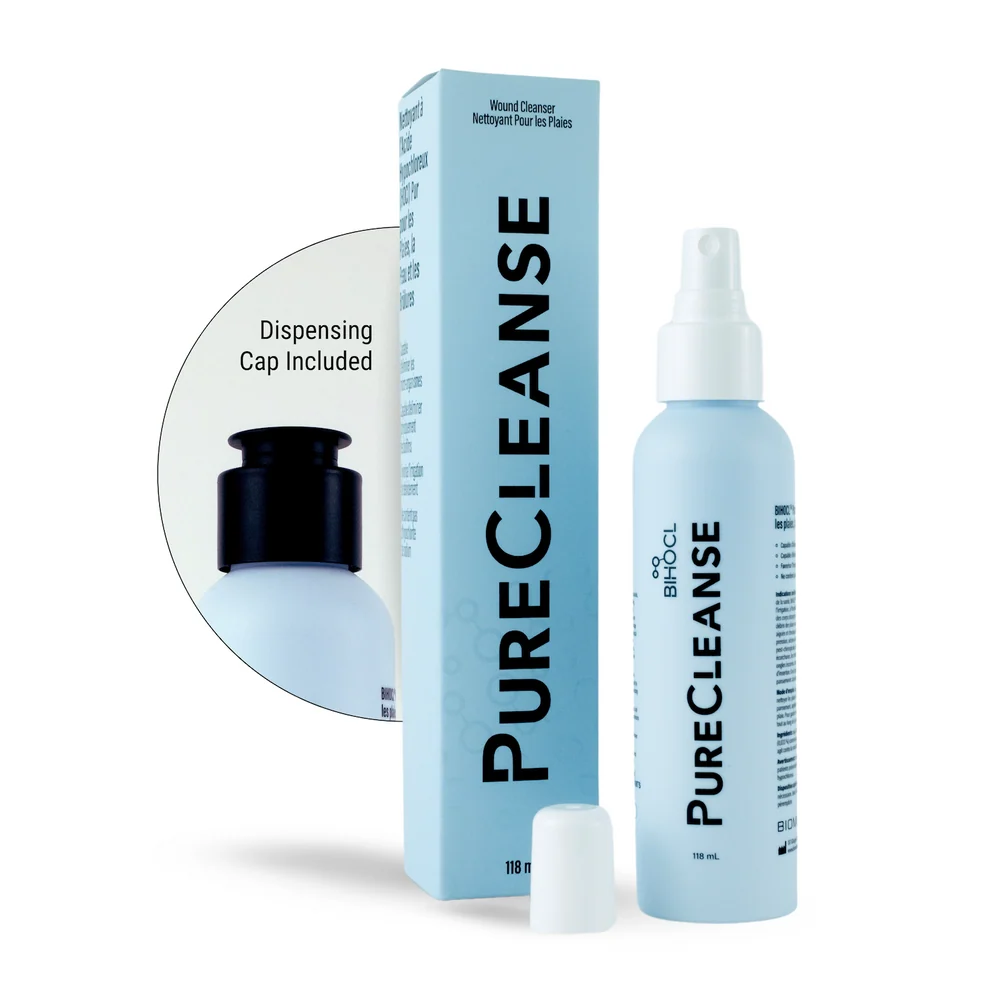
According to the manufacturer, the formulation contains water, sodium chloride (NaCl) and pure hypochlorous acid (HOCl) — with no buffers, no stabilizers, no additives and no sodium hypochlorite. The HOCl concentration is 0.033%, equivalent to 330 ppm.
Manufacturer-supported characteristics include antimicrobial wound cleansing, removal of microorganisms, physical disruption of biofilm, non-cytotoxicity, no-rinse use, sting-free application and a pure, stable formulation. Manufacturer claims remain attributed to the manufacturer — they are not converted into KidsPiercing.com clinical guarantees.
Canadian medical-device information
Health Canada’s Medical Devices Active Licence Listing identifies BIHOCL PURECLEANSE as a licensed Class II medical device under Medical Device Licence 108007. The licence establishes the medical-device regulatory status of the listed product. It does not mean Health Canada approves PureCleanse for kids’ ear piercing, and it does not mean Health Canada endorses the Tribal Expression aftercare protocol.
Why not just use a stronger antiseptic?
More aggressive germ killing does not automatically equal better wound aftercare. Healing tissue needs living cells to migrate, proliferate, rebuild extracellular matrix and restore an epithelial barrier — and some traditional antiseptics can become cytotoxic to the very cells involved in tissue repair. Modern wound cleansing therefore looks for an important balance: antimicrobial effect plus tissue compatibility. That balance is a major reason Tribal Expression became interested in stabilized HOCl. For what we do not recommend instead, see why rubbing alcohol isn’t routine aftercare and the full Aftercare Knowledge Centre.
Is HOCl an antibiotic?
No. HOCl is an oxidizing antimicrobial, antiseptic-type wound-cleansing agent. It does not operate like a conventional prescription antibiotic targeted to a specific bacterial process, and it is not a replacement for medically indicated antibiotic treatment.
Does PureCleanse need to be rinsed off?
According to the manufacturer, no rinse is required. We do not advise a routine water rinse after PureCleanse unless another established Tribal Expression procedure specifically requires one.
How Does Tribal Expression Use Hypochlorous Acid for Ear-Piercing Aftercare?
Tribal Expression uses PureCleanse as the wet cleansing solution within our structured piercing-aftercare method. For an uncomplicated new kids’ ear piercing, our standard routine is cleaning morning and evening. For each ear: hands are washed first; three completely fresh cotton swabs are used; the swabs are thoroughly saturated with PureCleanse; cleaning proceeds gently around the jewellery front and flat back from front to back; each swab is discarded after use; and the jewellery is not deliberately twisted or spun. Before moving to the second ear, hands are washed again — and the second ear receives three completely new swabs.
This page explains the science. For the complete procedural instructions, see how to clean your child’s new ear piercings.
HOCl does not mean “spray it and forget about it”
Within Tribal Expression’s protocol, PureCleanse provides the solution and gentle cleaning provides controlled mechanical removal of softened healing debris. The goal is not aggressive scrubbing. The goal is: wet and soften, gently clean, then leave the piercing alone. Technique still matters — and over-cleaning is its own problem: can you over-clean a new ear piercing?
What We Do Not Claim
KidsPiercing.com and Tribal Expression do not claim that HOCl:
- guarantees perfect healing
- prevents every infection or treats every infection
- eliminates every biofilm
- makes jewellery fit irrelevant, prevents irritation from pressure, or prevents snagging
- fixes incorrectly sized jewellery
- replaces good cleaning technique, professional assessment or medical care
- makes over-cleaning beneficial
- means normal healing debris is “bacteria”
- is harmless at every possible concentration
- has been proven in clinical trials specifically for every type of piercing
WHAT ACTUALLY HEALS THE PIERCING?
YOUR BODY.
Aftercare does not manufacture new tissue. The body performs the biological repair. Our job is to provide an environment that supports that process by reducing unnecessary contamination, pressure, trauma and irritation while maintaining appropriate jewellery and sensible cleansing.
If you’re unsure, come see us. Tribal Expression provides free piercing consultations for healing concerns — book a consultation or contact the studio.
Written by Keith · Reviewed by Keith · Reviewed September 8, 2026 · Updated September 8, 2026
Ready to see the studio for real?
Book a visitThis guide shares general knowledge, not specific medical advice — your studio and your family doctor know your child best.